RoRI launches META-MOMENT: the largest comparative global study of metascience
May 19, 2026
The Research on Research Institute (RoRI) is launching META-MOMENT, the largest comparative study to date of developments in metascience across 21 countries.
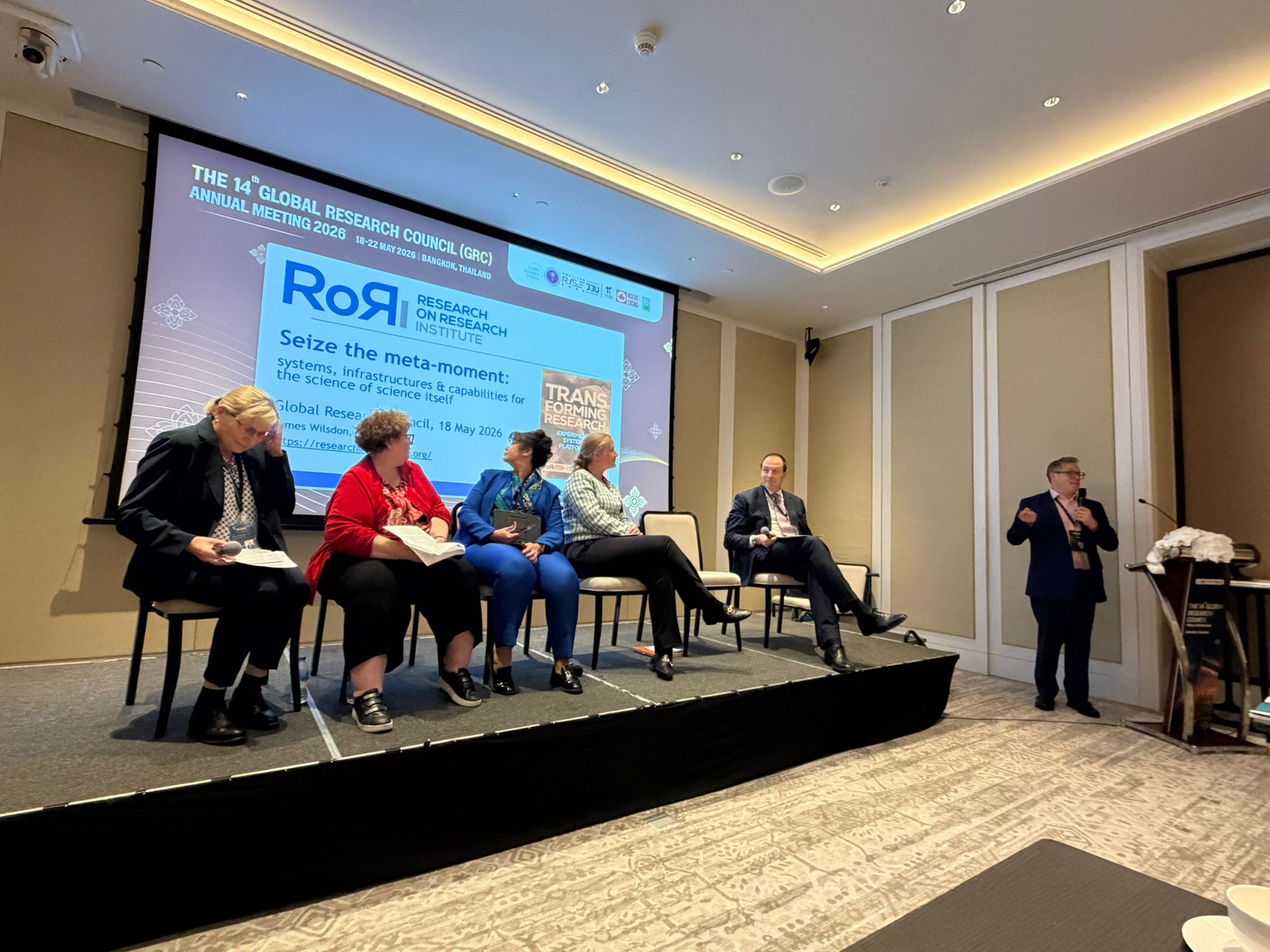
The initiative was introduced at the 14th Annual Meeting of the Global Research Council (GRC) in Bangkok, where RoRI’s James Wilsdon joined a panel of funding leaders from UKRI (UK), ARC (Australia), SSHRC (Canada), NCRST (Namibia), RCN (Norway), JST (Japan), and NRF (South Africa) to discuss how metascience is reshaping national research systems.
Announcing the project, James Wilsdon, Executive Director of RoRI, said:
“We need to seize this metascience moment. Across many research systems, metascience is moving into the mainstream. Governments are setting up dedicated units, funders are building internal capabilities and making targeted investments. With this new project, RoRI is working with partners across 21 countries to map and make sense of what is happening, and to develop practical resources for decision-makers who want to make the most of this momentum.”
At the GRC’s annual meeting in Bangkok, a panel of funding leaders emphasised the value of metascience as a resource for the research funding community.
Opening the session, Professor Sir Ian Chapman, CEO of UK Research and Innovation (UKRI), challenged funding bodies to go further to question, test, and improve their own investment strategies.
“At UKRI, I am only too aware of the persistent irony that we invest in the most cutting-edge science and innovation, but we’ve been far less scientific about our own funding practices,” Chapman stated. “I really believe we have to change that. That commitment to being more rigorous about our own practices is why we established the UK Metascience Unit.”
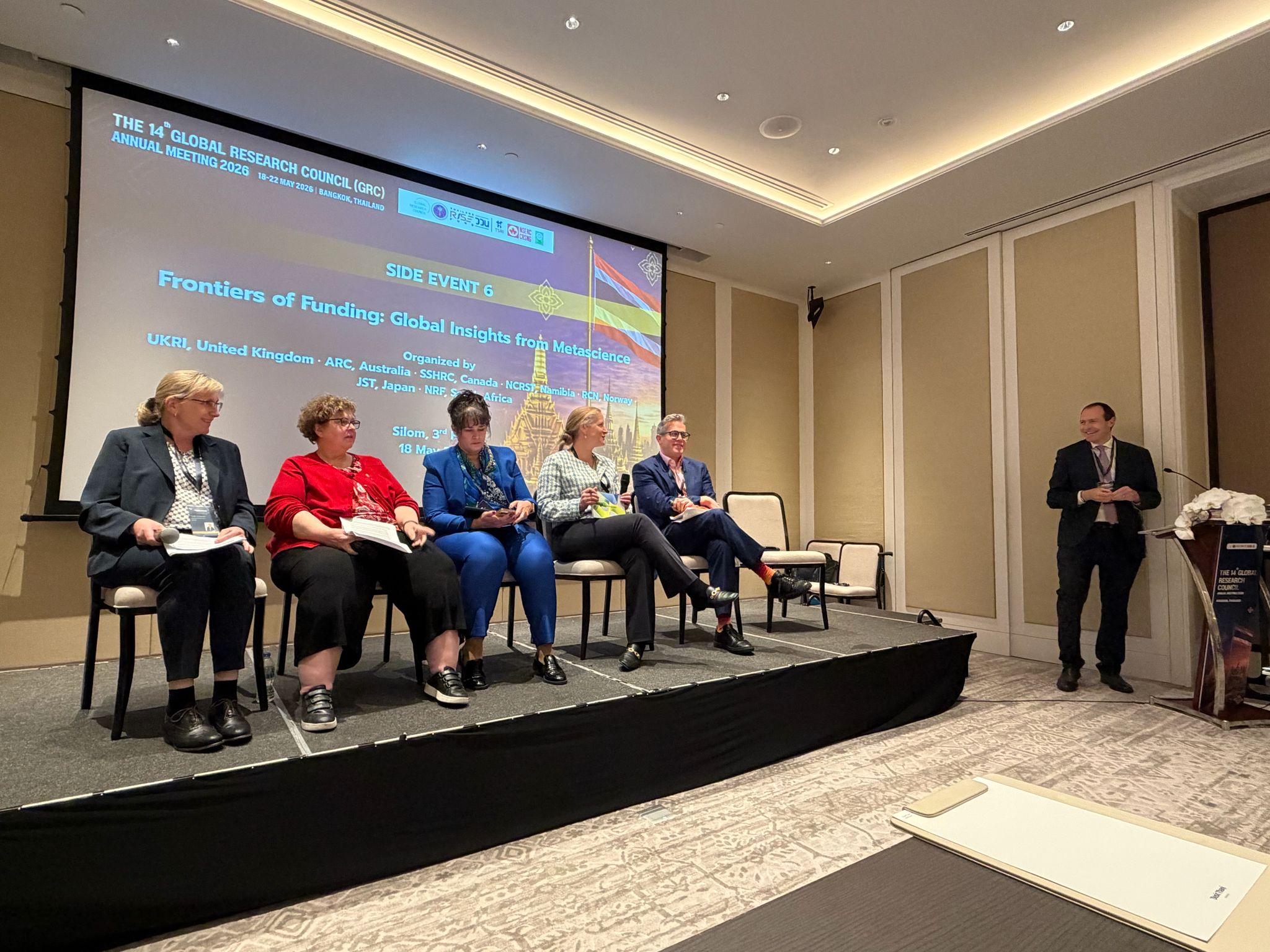
Commenting on the growing engagement with metascience visible in many research systems, he added: “This global momentum really matters. We share many of the same priorities, and by working together we hope that we can build an evidence base much faster than if we just did it on our own. International collaboration has always been central to our approach to metascience.”
Echoing the global scale of the challenge, Mari Sundli Tveit, Chief Executive of the Research Council of Norway (RCN), noted that as global R&D spending continues to climb, so do expectations for institutional transparency and efficiency.
“At RCN, we believe that building knowledge in this field and generating insights into how we can better organise and fund research and innovation endeavors is more important than ever,” Sundli Tveit said. “The expectations that we do it in the right way are there—we need to be accountable to society at large.”
Prof. Dr. Anicia Peters, CEO of Namibia’s National Commission of Research, Science and Technology (NCRST), emphasised that the rapid rise of AI poses new metascientific questions for global equity:
“AI is fundamentally altering how research is proposed, reviewed, and synthesised,” stated Prof. Dr. Peters. “This raises critical governance questions for us. How do we ensure transparency and accountability, and prevent AI systems from reproducing existing inequalities in global science? And for many African countries, how do we ensure that developing research systems are not left behind in terms of these transitions? Unequal access to digital infrastructures, computational resources and AI capabilities could deepen existing disparities. At the same time, AI could enable us to leapfrog longstanding constraints in administrative efficiency, reviewer matching, grant management, evidence synthesis and collaboration.”
Prof. Ute Roessner, CEO of the Australian Research Council (ARC) described how the ARC has drawn on metascience in the development of its new national assessment framework, known as Research Insights Capability (RIC) which is being built mostly on open source data.
Prof. Roessner also said: “The biggest challenge for us is still how do you measure impact? How do you demonstrate the value of research? For us, metascience initiatives are so important because then we can demonstrate to society and to the government how important it is to fund research. So we are very supportive and looking forward to exploring how to present this data in an interesting way, so people can drill through information across all disciplines, across all institutions, and across countries. These are exciting times.”
Prof. Sylvie Lamoureux, Chief Operating Office and Vice-President, Social Sciences and Humanities Research Council of Canada (SSHRC), outlined why SSHRC values metascience:
“Fundamentally we aspire to be a learning organisation, and to keep Canada at the forefront of research funding practice. Metaresearch helps to challenge our assumptions, improve our internal processes, and tackle challenges that funders around the world are facing, such as peer review fatigue, the use of AI, and increasing volume and quality of submissions. It is also playing a big role in rethinking research excellence and impact, notably by helping funders like SHHRC to devise ways of valuing invisible labour, like co-creation, community building and policy influence, which are important pathways to impact in the social sciences.”
Finally, Prof. Kazuhito Hashimoto, President of the Japan Science and Technology Agency (JST) described recent developments within the Japanese system:
“Our national strategy, the 7th Science, Technology, and Innovation Basic Plan, which formally launched in April 2026, is deeply aligned with the metascience movement. Our goal is to revitalise science by reforming how we fund and evaluate research. We believe there is no single correct answer for these reforms. Every system must be tested and improved step by step. Our action must be guided by evidence, not assumption.”
The enthusiasm for metascience evident across the panel at the GRC meeting is reflected in many of the countries that the META-MOMENT project will analyse. Other examples include:
- Ireland: where Research Ireland committed in March 2026 to establishing a meta-research unit to provide evidence-based insights for national research policy;
- Germany: where the Volkswagen Foundation runs a dedicated programme for “Researching Research”;
- The United States: where the National Science Foundation (NSF) recently asked Congress for funding to establish a dedicated metascience unit that will champion greater agency-wide experimentation;
- China: where the recent “Shanghai Declaration on the Science of Science” called for greater investment in the field.
Running across 21 countries, RoRI’s META-MOMENT project will capture these and other developments by mapping the changing mix of institutions, investments and capabilities in each national system. The study will combine scientometric and network analysis with expert interviews and workshops, and will produce a landmark report in November 2026.
Led by RoRI researchers at UCL, and supported by over 16 partner organisations and 21 country research teams, META-MOMENT will deliver the most comprehensive overview of global metascience to date, helping governments, funders, and research organisations to better navigate and fulfil the potential of this “metascientific moment.”
For more information about the project or to connect with the research team, please contact RoRI Research Fellow Seunghyun Lee at s.lee@researchonresearch.org.



